Product Design Business Design Consumer Goods Mobile & Web

Diageo
DiageoLink:
From sales visits to self-serve orders.

DiageoLink connects Diageo with the outlets that sell their products, covering orders, invoices, payments, and product discovery. Redesign designed the product, the business model, and the service model across three phases, including an AI-powered recommendation engine that sends outlets a suggested order for one-tap approval.

The Challenge

The sales rep
was the system.

Diageo's relationship with outlets, the bars, restaurants, and liquor stores that stock and sell their products, ran almost entirely through personal contact. Sales reps visited outlets to take orders, communicate promotions, handle invoices, and answer questions. There was no shared digital channel. Orders were placed by phone or in person. Invoices arrived by email or in print.

This created two parallel problems. Outlets had no visibility into their own order history, invoice status, or product catalog without contacting a rep. Sales reps, meanwhile, were spending their time on coordination and transaction management instead of the commercial activity they were actually hired for. The more outlets a rep carried, the more time was consumed by administration.

Diageo needed a product that outlets would genuinely adopt, not another back-office tool forced on them, and that would free sales reps to focus on relationships and growth rather than order-taking. The scope was broader than UX design: it required rethinking the service model and the commercial logic of how Diageo and its outlets interact.
How We Worked

Three phases, from idea
to AI-powered product.

Redesign took full ownership across product design, business design, and service model design, structured across three phases that progressively raised the product's capability.

01
Discovery: Validate before building
Before committing to development, Redesign ran a discovery phase to test whether outlets would actually use a self-serve digital channel. Prototypes were built and tested with real outlet operators. Research focused on ordering behavior, decision-making patterns, and the conditions under which adoption would or would not happen. The service model was also designed at this stage: how DiageoLink would change the role of the sales rep, not eliminate it, and how the commercial relationship would need to adapt.
02
UX, UI design and development: Six product areas, two platforms
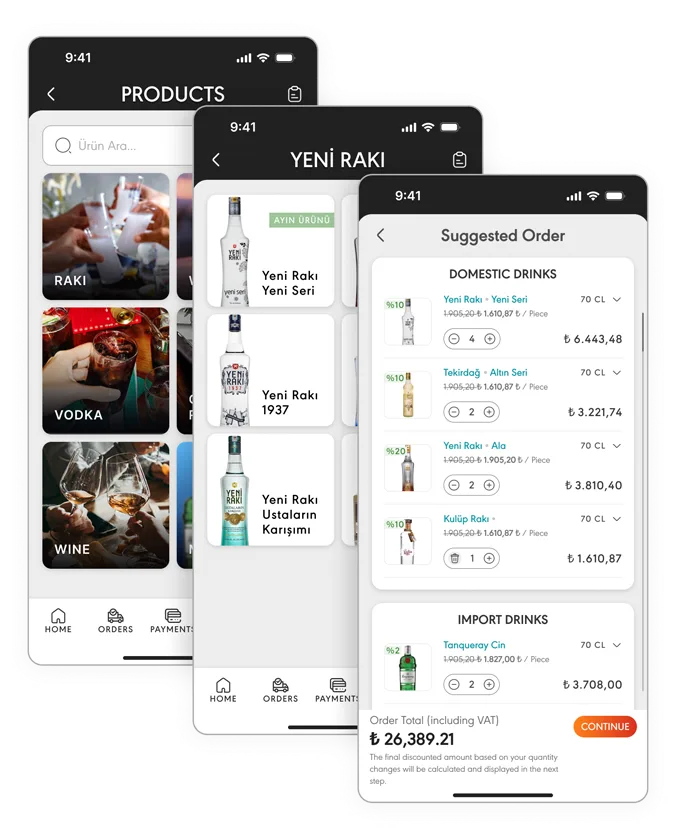
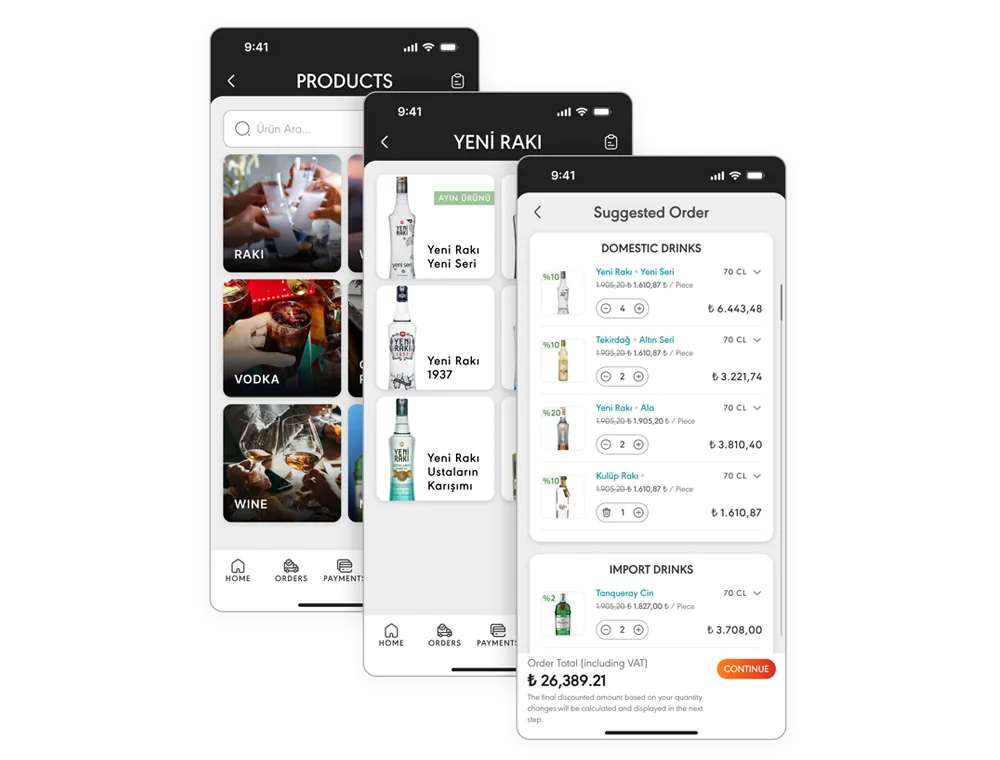
The pilot scope covered six areas: Orders (order confirmation, order history), Payments (invoices), Products (catalog, frequently ordered items, favorites), Home (highlights, notifications), Reports (monthly revenue, period comparisons), and CRM (loyalty points, surveys). Designed and developed for both mobile and web, with mobile-first priority since outlet staff primarily work on phones. Redesign owned design and development end-to-end through to live deployment.
03
Phase 3: AI-powered order recommendations
The third phase introduced an AI recommendation engine that analyzes each outlet's order history and generates a suggested order. The outlet receives a pre-built order proposal based on their patterns: they review it, adjust if needed, and approve in one tap. This removes the cognitive burden of deciding what to order and when, reduces the friction that previously caused outlets to delay or skip orders, and gives Diageo's sales team better signal on outlet demand without requiring a rep visit to capture it.
The Outcome

Outlets ordering independently.
Reps selling instead of taking orders.

3
Phases: discovery, full-product launch, AI recommendation engine
6
Product areas in pilot: Orders, Payments, Products, Home, Reports, CRM
2
Platforms designed and built: mobile app and web portal

DiageoLink gave outlets a direct digital channel to Diageo. They could browse the product catalog, place orders, view invoices, track payments, and access loyalty and CRM information without contacting a sales rep. The most visited areas confirmed that ordering and account management were the core use cases that drove adoption.

With the AI recommendation engine in Phase 3, the ordering experience shifted from active to passive for outlets. Instead of deciding what to order, outlets receive a suggestion based on their history and approve it with a single tap. This reduced ordering friction and increased order frequency, while giving Diageo's commercial team cleaner demand signals across the outlet network.

The scope of the engagement extended beyond product design. Redesign redesigned the service model around DiageoLink, changing how sales reps spend their time and how the Diageo-outlet relationship is structured. The rep's role shifted from order-taker to relationship manager, with the product handling the transactional layer.

Need a B2B product that changes
how your commercial model works?

Redesign designs the product, the business model, and the service model together. If the product needs to change how your team and your customers operate, that is the work we do.

Start the conversation →